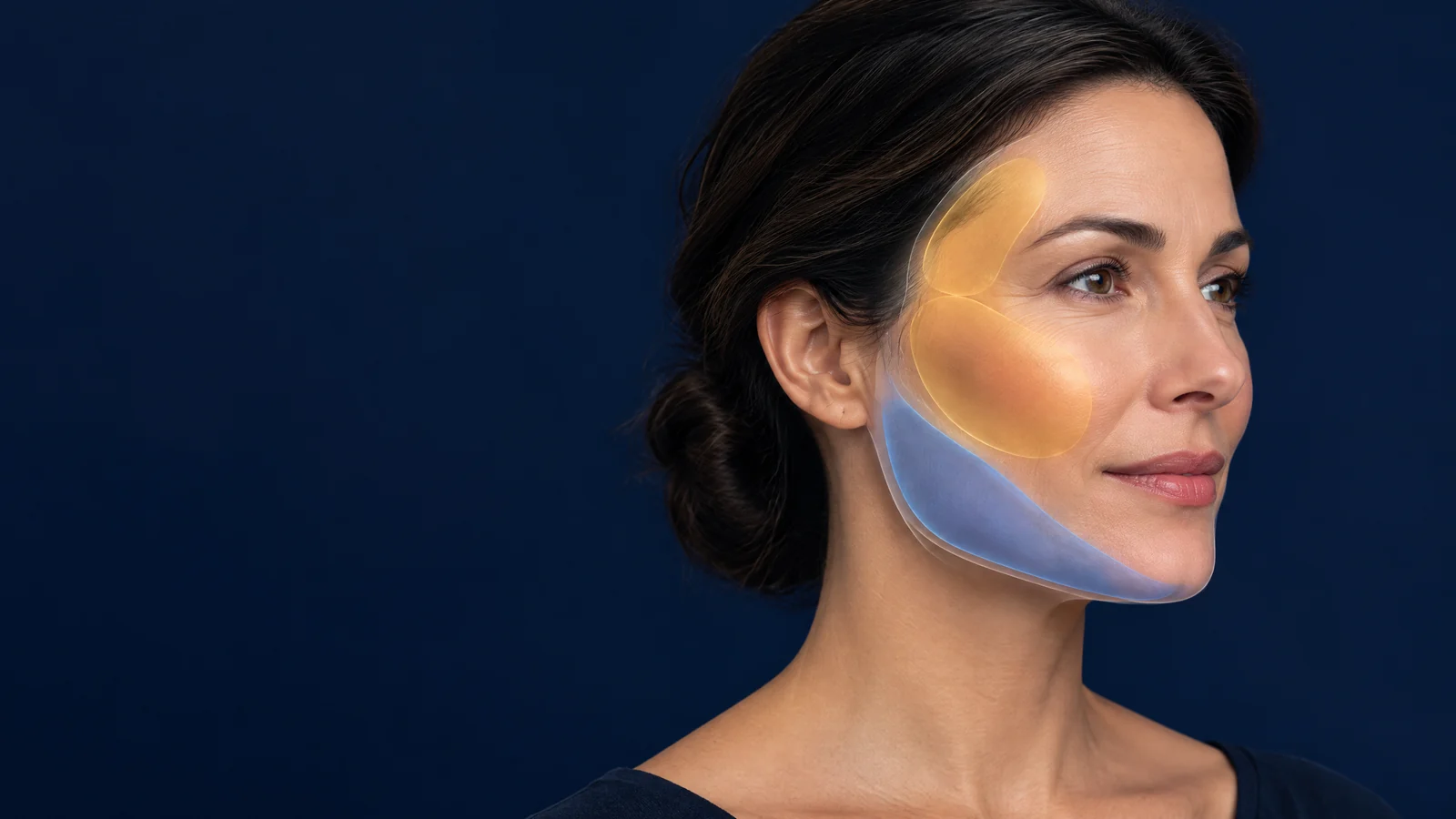
Facial fat transfer is a volume-restoration procedure, not a substitute for every facelift, filler, skin-quality treatment, or contour concern. A clear consultation separates three questions: where volume is missing, where tissue has descended or become lax, and what each part of a proposed plan is intended to address.
Last reviewed: September 2026. This guide is for education and consultation preparation. It does not replace an examination, medical advice, a personalized surgical recommendation, or an informed-consent discussion of risks.
Start With What You Are Trying to Change
“My face looks tired” can describe several different observations: hollow temples, a flatter cheek, shadows beneath the eyes, folds around the mouth, jowls, loose skin, or a change in facial proportions after weight loss. These are not interchangeable findings. A treatment discussion is more useful when it separates volume, tissue position, and skin quality before naming a procedure. [1] [2]
Facial fat transfer uses fat taken from the same person to add soft-tissue volume or improve contour in selected areas. A facelift is designed to address selected laxity and descent in the face and neck. Some people may discuss one approach, some may discuss both, and some may be better served by a different or nonsurgical option. A photo, an age, or a procedure label cannot make that decision. [3] [4]
Facial-change vocabulary
Lift, volume, skin—or more than one?
This is a discussion framework, not a self-diagnosis or treatment selector. A clinical examination is what determines whether a proposed plan matches the concern.
01
Volume
Hollowing or flattening in selected facial areas may lead to a discussion of volume restoration. Fat transfer is one possible source of volume; it is not appropriate for every area or concern.
Ask: Which areas are actually volume-deficient in my case?02
Position & laxity
Jowls, loose lower-face skin, or facial descent are questions about tissue position and laxity. Adding volume does not automatically reposition loose tissue.
Ask: What part of my concern is a lifting question?03
Skin quality
Sun damage, pigmentation, texture, and fine lines are surface and skin-quality questions. They may need a separate conversation from lifting or volume.
Ask: Which parts of my goal are not a volume or lifting issue?04
A combined pattern
Some people show both selected volume loss and tissue laxity. A surgeon may discuss a combined or staged plan after considering anatomy, health, recovery, and goals.
Ask: What does each component add—and what does it not change?
Conceptual planning illustration: warm-gold areas represent selected facial-volume questions, the cool-blue area represents lower-face tissue-position questions, and the surface layer represents skin-quality questions. These overlays do not diagnose anatomy or show a predicted outcome. Click to enlarge
What Facial Fat Transfer Involves
Facial fat transfer has two treatment areas: a donor area, where fat is collected, and a recipient area, where it is placed in the face. The procedure generally involves harvest, preparation, and careful placement of small amounts of tissue. Published methods vary in donor-area choice, harvest approach, processing, cannula selection, placement plane, and injection technique. No single donor area or processing approach is universally best in the available evidence. [1] [5]
Commonly discussed recipient areas include the temples, cheeks or midface, tear-trough region, folds around the mouth, lips, and other localized contour deficits. Whether a specific area should receive fat depends on blood supply, tissue thickness, prior procedures, facial proportions, skin quality, and the desired relationship between adjacent features. [3] [5]
Two areas, three stages
What a facial fat-transfer plan should make explicit
The exact method is not standardized. Use this map to ask the surgeon about the proposed plan rather than assuming every fat-transfer procedure is the same.
01
Donor-area plan
Ask where tissue would be collected, why that area is selected, how liposuction is performed, and what donor-site recovery or care would be involved.
Donor-site treatment has its own healing and contour limits.02
Preparation approach
Ask how the collected tissue is prepared for placement and why that method is being recommended. Published methods differ, and evidence does not identify one universal best process.
Technique variation is not a guarantee of retention or result.03
Facial placement plan
Ask which exact facial areas are being considered, what volume goal is realistic, and how the plan avoids treating every hollow or shadow as a volume problem.
Recipient-site anatomy and safety shape what can be placed.
Why a Facelift and Fat Transfer May Be Discussed Together
Facial rejuvenation can involve more than one type of change. A facelift may be considered to reposition selected lax facial and neck tissues. Fat transfer may be considered to restore volume in selected areas. Neither statement means that every facelift needs fat transfer or that fat transfer makes a facelift unnecessary. [2] [3]
A systematic review of combined facelift and fat-grafting studies found improved volume and aesthetic assessments in the reported literature, but the evidence was Level III, techniques varied, and the authors called for additional research. That supports a careful, individualized discussion of a combined plan—not a promise that the combination is superior for every patient. [6]
For a broader overview of the practice’s facial fat-grafting service, procedures beyond the face, and verified patient galleries, visit Dr. Ching’s main fat-grafting service page. The role of this guide is different: to help patients ask better questions before a consultation.
Retention Is Real—but It Is Not a Fixed Percentage
Transferred fat needs to establish a blood supply in its new location. Some of the initially placed volume may be absorbed, while some may integrate. The amount that remains cannot be predicted exactly before surgery. [1] [7]
Published retention estimates vary substantially. Studies differ in facial region, patient selection, technique, follow-up duration, and how researchers measure volume. A meta-analysis found that the measurement method itself meaningfully influenced reported retention. For that reason, a published average should not be presented as a forecast of an individual result. [1]
Retention-planning tool
Three truths to carry into a consultation
What is placed first
Early fullness is not the final contour
Initial appearance can reflect postoperative swelling as well as placed volume. It evolves during healing.
What biology decides
Integration varies
Not all transferred fat persists. The individual course depends on the recipient area, technique, healing, health, and biologic variability.
What research can say
Studies describe ranges—not your guarantee
Different measurement methods and follow-up periods produce different reported retention estimates. Ask for an individualized explanation instead of a percentage promise.
A responsible plan discusses uncertainty, the possibility of under- or over-correction, and whether a refinement might be considered. It does not promise one session, a permanent result, or a specific final date.
Recovery Includes Both the Face and the Donor Area
When facial fat transfer is combined with a facelift, recovery should be planned around the combined operation, not fat transfer alone. Facial dressings, possible drains, bruising, swelling, medication instructions, activity restrictions, transportation, home support, travel, and follow-up should all be discussed with the operating surgeon. [8] [9]
The donor area also needs a plan. Tenderness, bruising, swelling, contour irregularity, wound concerns, and the possible need for compression or other care depend on how and where tissue is collected. The practice’s written postoperative instructions—not a generic web timeline—should govern activity, return to work, exercise, travel, and follow-up. [3] [8]
Combined-recovery organizer
Plan two recovery conversations, not one
Facial recipient area
What swelling, bruising, dressings, or drains are possible?
Which signs should trigger an urgent call?
When may I sleep, wash, walk, work, exercise, or travel as instructed?
Donor area
Where is tissue planned to be collected, and why?
What pain, bruising, swelling, garments, or wound care are expected?
What contour changes should I not expect from the donor-area step?
Whole-plan support
Who brings me home and is available the first night?
What medications, nicotine, supplements, or health issues need review?
How will follow-up work if I live on another island or travel?
Risks Need a Direct, Balanced Conversation
Expected short-term effects can include swelling, bruising, tenderness, and donor-site discomfort. Reported local complications include asymmetry, contour or texture irregularity, over- or under-correction, fat necrosis, infection, and the possible need for revision. Published complication reporting is inconsistent, so a low number in one study should not be translated into a personal “low-risk” guarantee. [5] [10]
Facial fat injection also carries a rare but potentially devastating vascular risk. Systematic case-based literature documents visual compromise, stroke, and death after arterial embolism. Those reports do not provide a reliable personal incidence, but the risk belongs in informed consent. Ask how the surgeon discusses, works to prevent, recognizes, and responds to vascular complications. [11] [12]
When combined with a facelift, the total discussion should also cover anesthesia-related events, bleeding or hematoma, fluid accumulation, infection, nerve weakness or injury, wound- or skin-healing problems, scarring, sensory changes, prolonged swelling, asymmetry, and unsatisfactory results. Health conditions, nicotine exposure, medications and supplements, blood pressure, prior procedures, and healing history can all change the conversation. [9] [13]
What About SVF or “Enriched” Fat?
SVF, or stromal vascular fraction, is a term used for a mixed population of cells obtained from fat tissue. Research on cell-assisted or SVF-enriched facial fat grafting is active. Some studies have reported higher average retention in certain comparisons, but methods differ, many studies are small or observational, and results do not establish a guaranteed patient-level benefit. A small 2024 randomized study found higher MRI-measured retention through 24 weeks but no significant difference in patient-rated aesthetic scores; systematic reviews continue to call for larger, standardized, long-term research. [14] [15] [16]
FDA guidance distinguishes ordinary preparation that cleans or sizes tissue from processing intended to isolate cellular components. The regulatory implications of a particular protocol depend on the exact processing and intended use. This guide does not determine the regulatory status of any practice-specific protocol. If SVF or another enrichment method is part of a proposed plan, ask what is being placed, how it is processed, what evidence supports the intended benefit, what uncertainty remains, and what alternatives exist. [17] [18]
Evidence & protocol questions
Separate a practice fact from a research conclusion
Practice fact
“What exactly does this practice do?”
Ask for the name of the proposed processing method, whether ordinary prepared fat or isolated cellular components are involved, and why the protocol is being recommended for your plan.
Research question
“What does published evidence support?”
Ask which study population, processing method, follow-up period, and outcome measure are relevant. A study average is not an outcome promise for a different patient or protocol.
Decision question
“What changes if I decline this component?”
Ask which concern the added step is intended to address, what its separate recovery and risk implications are, and what alternative approaches could be discussed.
Use Before-and-After Photos as Evidence With Context
Photographs can help you understand a surgeon’s aesthetic judgment and discuss a realistic goal. They should not function as a promise or a substitute for an examination. ASPS notes that pose, angle, lighting, expression, selection bias, editing, timing, and individual healing can all change what a result appears to show. [19]
Photo-reading lab
Six checks before a facial fat-transfer photo informs a decision
Same patient & exact proceduresConfirm every procedure performed. A facelift, neck procedure, eyelid surgery, skin treatment, or filler dissolution may affect what you see.
Areas treated with fatAsk which areas received fat and which visible changes come from a separate lifting or skin treatment.
Matched position & expressionCompare frontal, oblique, and profile views with similar head position, posture, neutral expression, hair, and ear visibility.
Matched camera conditionsCompare framing, distance, perspective, lighting, background, exposure, makeup, and styling before assigning a change to surgery.
Stated follow-up timeAsk when the after image was taken. Swelling, scar maturation, and volume settling evolve over time.
Comparable starting concernLook for patients with a similar starting pattern and goal. A selected example informs a discussion; it does not predict your result.
How to Evaluate the Surgeon, Facility, and Plan
Ask for precise, verifiable information rather than relying on a procedure name or a marketing adjective. Patients can verify a plastic surgeon’s certification through the American Board of Plastic Surgery’s public verification tool. For an out-of-hospital surgical setting, ask how to verify current accreditation, state licensure, or Medicare certification where applicable. [20] [21]
A qualified consultation should also explain who provides anesthesia, where the procedure occurs, who performs each part of care, how after-hours concerns are handled, what follow-up is planned, and how complications or a disappointing outcome would be managed. [13] [22]
Consultation decision tool
Ten questions to bring to a facial fat-transfer consultation
What is the main source of the concern I see?Ask the surgeon to separate volume loss, tissue descent/laxity, skin quality, and structural features.
Which areas would you consider treating with fat—and why?Ask what the plan is intended to improve and what it is not designed to change.
Would you discuss fat transfer alone, facelift alone, a combined plan, or neither?Ask how anatomy, goals, health, and recovery tradeoffs shape that recommendation.
Where would donor tissue be collected?Ask why that location is chosen and what donor-site care, limits, and risks apply.
How will the tissue be prepared and placed?Ask for the method in plain language, including the rationale for the proposed approach.
What retention uncertainty should I expect?Ask how the surgeon handles under- or over-correction and when a refinement might be discussed, without expecting a percentage promise.
What does the proposed plan add to recovery?Confirm facial and donor-site recovery, support needs, medication plan, activity restrictions, travel, and follow-up.
What are the local and serious risks?Ask specifically about asymmetry, irregularity, infection, fat necrosis, vascular risk, urgent warning signs, and after-hours contact.
What facility and anesthesia plan applies to me?Ask who provides anesthesia, why it fits the procedure and health history, and how facility status can be verified.
What photographs can I review?Ask for comparable, properly contextualized examples that state procedures, treated areas, and follow-up time.
Dr. Ching’s Approach: A Separate Conversation About the Ascend Lift™
The Ascend Lift™ is Dr. Shim Ching’s trademarked, multi-tiered facial-rejuvenation protocol. When he recommends a facial-volume component after examination, the proposed plan should identify the specific concern it is intended to address, the treatment areas, technique, recovery implications, material risks, and uncertainties.
A private evaluation is where the relevant distinctions are made: whether the concern is volume, laxity, skin quality, or a combination; whether fat transfer is appropriate; whether other treatment should be discussed; and what a personalized surgical plan may or may not address. For the main practice’s service information, broader gallery, and scheduling route, visit Facial Fat Grafting at Asia Pacific Aesthetics.
Frequently Asked Questions
What is facial fat transfer?
Facial fat transfer, also called facial fat grafting or lipofilling, uses a person’s own fat to add volume or improve contour in selected facial areas. It involves harvesting fat from a donor area, preparing it, and placing small amounts in a facial recipient area. The exact donor and recipient sites depend on anatomy and the treatment plan.
Can fat transfer be combined with a facelift?
It may be considered when an assessment identifies both facial tissue laxity or descent and selected areas of volume loss. A facelift and fat transfer address different features of facial aging; neither automatically replaces the other. Whether they should be combined depends on examination findings, goals, health, recovery considerations, and the surgeon’s recommendation.
How much transferred facial fat survives?
Not all transferred fat persists, and the amount that integrates varies among people. Published retention estimates vary substantially because studies differ in technique, treated area, follow-up duration, and how volume is measured. A responsible consultation should not promise a percentage, a permanent result, or that one session will be sufficient.
Does facial fat transfer have risks?
Yes. Expected short-term effects can include swelling, bruising, tenderness, and donor-site discomfort. Possible local complications include asymmetry, contour or texture irregularity, over- or under-correction, fat necrosis, infection, and the possible need for revision. Facial fat injection also carries a rare but serious vascular risk that can include visual or neurologic injury. Individual risks should be discussed with the treating surgeon.
What should I ask about a practice’s SVF or enriched-fat technique?
Ask what is being placed in the face, how the tissue is processed, whether cell isolation or enzymatic digestion is used, what the intended benefit and uncertainties are, and how the protocol differs from ordinary prepared fat. FDA guidance distinguishes ordinary preparation that cleans or sizes tissue from processing intended to isolate cellular components. The regulatory implications of a particular protocol depend on its exact processing and intended use.
How should I review facial fat-transfer before-and-after photos?
Confirm the same patient, comparable angle, expression, head position, lighting, background, and stated follow-up time. Ask every procedure performed, which areas received fat, and whether other treatment occurred. Choose examples with a similar starting concern when possible. Selected photographs are useful for discussion but do not predict an individual result.
Does a donor area provide a guaranteed body-contouring benefit?
No. The donor area is chosen to obtain tissue for the facial treatment plan. Liposuction and donor-site healing have their own limits and risks. A surgeon should explain the planned donor area, expected care, and what it is not intended to accomplish.
Discuss Volume, Laxity, and a Personalized Facial Plan
Meet with Dr. Shim Ching at Asia Pacific Aesthetics to discuss your facial anatomy, goals, options, recovery considerations, risks, and an individualized approach to facial rejuvenation.