Recognizability
Your features, expression, and identity remain central to the plan. The goal is not to replicate someone else’s face or an edited photograph.
Facelift Decision Guide
“Natural” is not a guaranteed surgical outcome or one technique label. It is a patient-centered goal: preserving identity and facial balance while addressing age-related concerns through an individualized, safe plan. This guide explains how to evaluate that goal, review photos intelligently, and ask better questions at a consultation.
This guide is educational. It does not replace a consultation, diagnosis, informed consent, or individualized advice from a qualified plastic surgeon. Every procedure has limitations and risks, and results vary.
When patients say they want a natural result, they usually are not asking for a perfectly unchanged face. They are asking to remain recognizable. They want their facial features and expressions to feel like their own, with changes that appear balanced, age-appropriate, and consistent with their goals.
The fear behind the phrase is often the “overdone” or overly tight look. The American Society of Plastic Surgeons notes that patients commonly associate an unnatural result with a windswept appearance, but it also emphasizes that many factors matter: a person’s anatomy, the vectors used in planning, prior treatments, surgeon qualifications, and safety. [1] A thoughtful consultation turns the broad request for “natural” into specific, realistic goals.
A patient-centered definition
These are discussion points, not promises. A surgeon should explain what is realistic for your anatomy and which tradeoffs come with the plan being considered.
Your features, expression, and identity remain central to the plan. The goal is not to replicate someone else’s face or an edited photograph.
The cheek, jawline, neck, eyes, skin quality, and volume concerns are considered together rather than treating one area in isolation.
A useful plan fits your own stage of life and goals. It does not require a dramatic transformation to be meaningful.
Scars, healing, swelling, sensation, asymmetry, and the possibility of revision or additional treatment should be discussed plainly—not promised away.
Terms such as skin-only, SMAS, deep plane, vertical lift, and mini facelift describe different approaches and areas of emphasis. They are not a reliable shortcut to a guaranteed outcome. A 2025 systematic review and meta-analysis found high patient satisfaction with both deep-plane and SMAS facelifts, while noting ongoing debate about comparative advantages and measuring outcomes across varied studies. [2]
That does not make technique irrelevant. It means the conversation should be more specific: What tissue changes are present? Which areas matter most to you? What does the proposed procedure address? What does it not address? What are the risks, scars, recovery demands, and alternatives? The right plan is an individualized clinical judgment, not a one-word marketing label.
Facelift planning has evolved beyond the idea that every patient needs the same amount of skin removal in the same direction. Contemporary surgeons may evaluate deeper support structures, tissue descent, volume changes, skin quality, the neck, facial proportions, prior procedures, and the way a person’s face moves. This does not mean every modern technique is interchangeable or that one approach is universally better. It means the evaluation can be more nuanced.
For example, a person who is concerned mainly with jawline and neck changes may need a different conversation from someone with midface descent, facial deflation, significant skin laxity, prior fillers, a previous facelift, or substantial recent weight change. A plan that respects these differences is more meaningful than a generic promise to “lift vertically” or eliminate all signs of surgery.
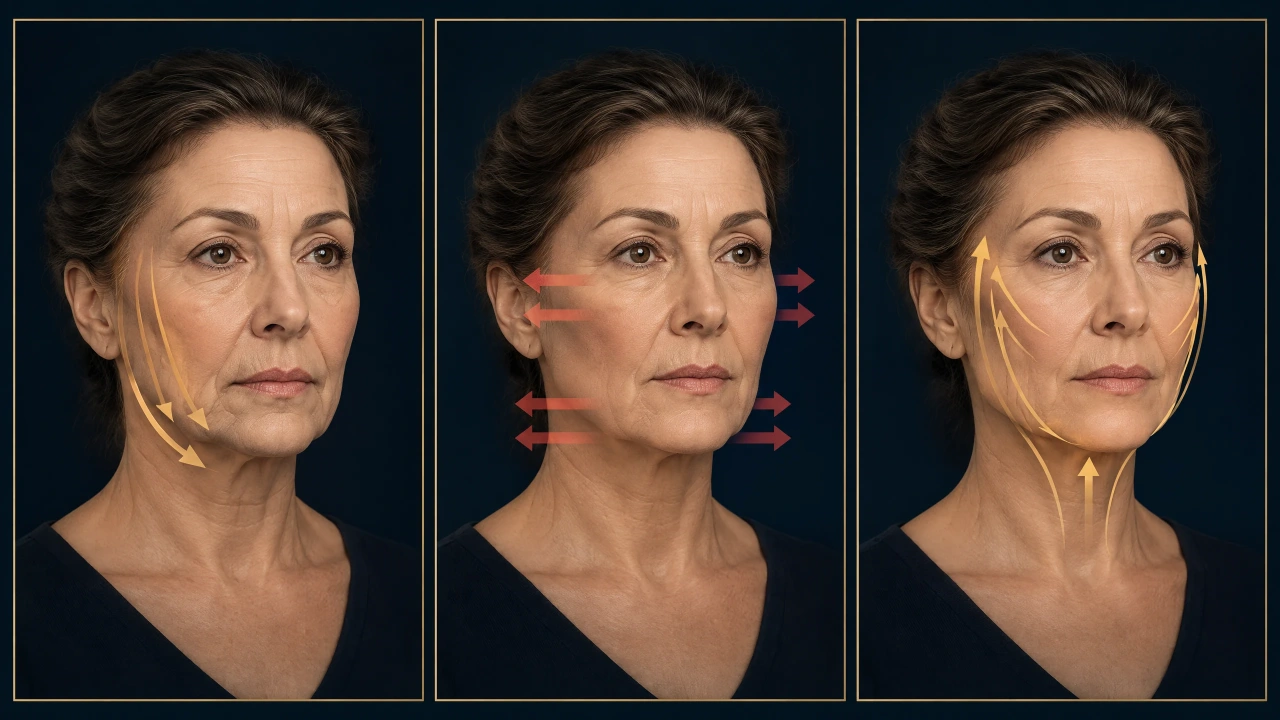
Patients often describe an undesirable result as looking tight, pulled, flat, or unlike themselves. Those words are useful because they point to specific concerns: whether the face still moves naturally, whether cheeks and jawline look balanced, whether the neck matches the face, and whether the earlobe, hairline, or scars draw attention.
Pixie ear is one recognized example of a change that can occur after rhytidectomy. Reviews of the condition discuss skin tension, excision, flap vectors, and earlobe attachment as relevant considerations. [3] It should be discussed as a risk and a planning issue—not used to imply that any surgeon or technique can promise its prevention. The same standard applies to scars and asymmetry: a responsible surgeon explains how they are managed and what might affect healing.
Before-and-after photos can help you understand a surgeon’s aesthetic judgment. They cannot tell you exactly what your own result will be. Lighting, lens choice, posture, makeup, hairstyle, facial expression, photo timing, weight change, skin treatments, and individual anatomy can all affect what you see.
The most useful gallery review is not, “Which person do I want to become?” It is, “Can I see how this surgeon approaches people whose concerns and starting point resemble mine?” Once your own Ascend Lift patient images are added to the microsite, they should be shown with clear consent, consistent photographic standards, date or healing-context information where appropriate, and no implication that they predict an individual outcome.
Photo-review framework
Bring these questions to a consultation. A good gallery supports a conversation; it does not substitute for an individualized examination.
Never judge a procedure from celebrity photographs, a single viral image, or a filtered social post. Those images cannot establish the operation, timing, prior treatments, or individual recovery behind the appearance.
When a public figure discusses cosmetic surgery, it can make the “natural versus overdone” question feel more concrete. But neither a public statement nor a photograph can reveal the full medical story. It cannot confirm the procedure, surgical plan, healing stage, prior treatments, weight change, styling, lighting, editing, or complications. It is not ethical or clinically useful to infer those details from an image.
Use public conversations as a prompt to clarify your own preferences—not as evidence that one named technique, surgeon, or aesthetic outcome is right for you. The better evidence is a private consultation, an honest health history, standardized patient photographs, and a discussion of the surgeon’s actual plan and results.
The Ascend Lift™ is Dr. Shim Ching’s trademarked approach to facelift and necklift planning. In a private evaluation, the meaningful question is not whether the name guarantees a natural result. It is how Dr. Ching evaluates your anatomy, the issues you want to address, and whether the proposed plan aligns with your goals and safety considerations.
A consultation should also identify what surgery cannot change. A facelift does not stop aging, remove every line, make skin behave like younger skin, or guarantee an outcome that is undetectable to others. The American Society of Plastic Surgeons notes that good outcomes are expected but cannot be guaranteed, and that additional procedures may be necessary in some situations. [4] That honest framework is the basis for an informed decision.
A natural-looking facelift is a patient-centered outcome goal rather than one procedure name. It generally means preserving a person’s recognizability and facial balance while addressing concerns in a way that fits their anatomy, goals, and healing process. No surgeon can guarantee an invisible or identical result for every patient.
No. Both deep-plane and SMAS facelift techniques can produce high patient satisfaction. The most useful question is how a surgeon evaluates your anatomy, goals, skin quality, prior treatments, safety, and the specific tradeoffs of the plan proposed for you.
A well-planned facelift aims to improve signs of facial aging without changing a person’s identity. However, every operation has limitations and risks. Discuss the amount of change you want, the features you want to preserve, and the realistic range of outcomes with your surgeon.
Look for consistent lighting, angle, expression, and time point. Review the entire face and neck—not just one area—and consider whether the person remains recognizable and balanced. Ask to see patients with concerns, facial structure, age range, and skin quality that are relevant to you.
No. Public photographs cannot establish the procedure performed, surgical plan, healing stage, prior treatments, lighting, editing, or whether the person even had surgery. Use celebrities only as a reminder to define your own goals, not as evidence that a technique will produce a specific result.
Pixie ear describes an earlobe that appears pulled downward or attached after facelift surgery. Published reviews discuss skin tension, excision, flap vectors, and earlobe attachment as relevant factors. It is a recognized risk and should be discussed as part of incision, scar, and complication planning rather than promised away.
No. Every surgery creates scars and results vary. A surgeon can explain incision placement, scar-management practices, healing factors, and the types of scars or healing changes that may occur, but no website should promise invisible scars or a universally undetectable result.
Meet with Dr. Shim Ching at Asia Pacific Aesthetics to discuss your anatomy, goals, prior treatments, surgical options, expected recovery, and the questions that matter when a natural-looking result is your priority.
Request a Private Evaluation