Verify qualifications
Confirm the applicable board certification, specialty training, licensure, hospital privileges where relevant, and the facts you can independently verify.
Ask: What credentials apply to the procedure I am considering?Honolulu & Hawaii Decision Guide
There is no objective “best” facelift surgeon for every person. There is a more useful process: verify qualifications and facility standards, review photographs critically, compare recommendations and follow-up plans, and choose the surgeon whose proposed plan you understand and trust.
This is an educational decision guide. It does not provide medical advice or determine candidacy. A consultation, examination, informed-consent discussion, and the surgeon’s individualized recommendations are essential before choosing surgery.
Searches for “best facelift in Honolulu” or “best facelift surgeon in Hawaii” often begin with a reasonable concern: you are considering a significant operation and want to choose carefully. But search ranking, a self-awarded title, a social-media following, or one dramatic photograph cannot answer the most important questions.
A stronger approach is to verify the matters that affect safety, judgment, communication, and continuity of care. The American Society of Plastic Surgeons advises patients to look for appropriate board certification, plastic-surgery training, ongoing education, and surgery performed in accredited, state-licensed, or Medicare-certified facilities. [1] Those are starting points for a conversation, not a substitute for your own evaluation.
A four-part selection pathway
Each step reveals a different part of the decision. Do not let an appealing gallery, price, or technique label stand in for the full picture.
Confirm the applicable board certification, specialty training, licensure, hospital privileges where relevant, and the facts you can independently verify.
Ask: What credentials apply to the procedure I am considering?Know where surgery occurs, who provides anesthesia, what facility oversight applies, and how the practice prepares for and responds to concerns.
Ask: Where will surgery be performed and how is safety organized?Review representative photographs critically, learn how the surgeon approaches concerns like yours, and ask what the gallery does not show.
Ask: Are the photos comparable and relevant to my situation?Understand the recommendation, alternatives, risks, recovery, estimate, follow-up, and what happens if you are dissatisfied or have a complication.
Ask: Do I understand the reasoning well enough to decide?Credentials are not a marketing detail. They help you understand a surgeon’s training pathway and the standards connected to their practice. Ask the surgeon which board certification applies, then use the board’s public verification tools where available. Do not assume that an official-sounding credential means the same thing as specialty-board certification.
The surgical environment matters as much as the title on a website. Ask where surgery will occur, whether the facility is accredited, state-licensed, or Medicare-certified as applicable, who provides anesthesia, and how emergencies or postoperative concerns are handled. ASPS includes these as core consultation questions for facelift patients. [2]
Experience also needs context. Instead of asking only, “How many facelifts have you done?” ask how the surgeon approaches concerns similar to yours: significant neck laxity, previous facial surgery, facial deflation, eyelid concerns, prior fillers or energy treatments, major weight change, or travel constraints. The answer should help you understand the reasoning—not simply deliver a sales pitch.
Before-and-after photographs can be valuable evidence of a surgeon’s aesthetic judgment. They can also mislead when lighting, angle, posture, framing, makeup, hairstyle, timing, or digital retouching are different. The American Society of Plastic Surgeons advises patients to look critically at photographs and not let them become the only basis for choosing a surgeon. [3]
A credible gallery should make comparison easier rather than harder. Clinical-photography literature emphasizes consistent lighting, background, framing, camera position, and unobstructed facial views. [4] When the practice adds Ascend Lift patient photographs to this microsite, those images should be presented with patient consent and clear standards—not as a promise that another person’s outcome is yours.
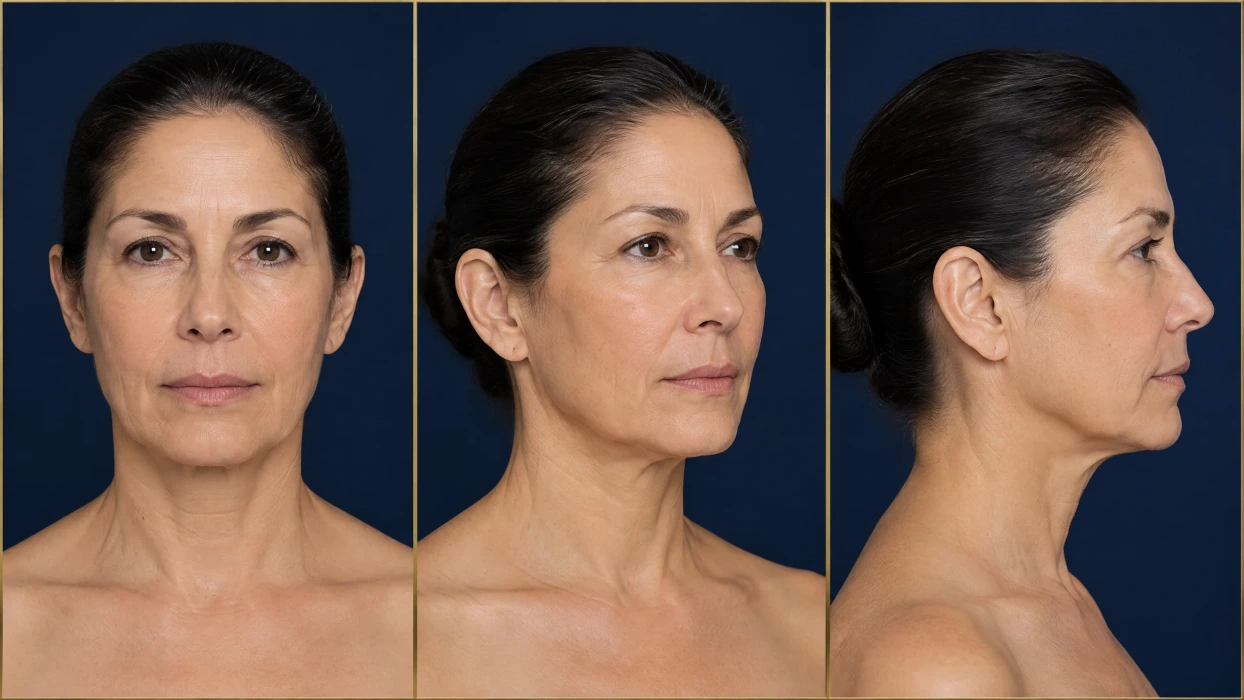
Before-and-after photo review
A strong gallery supports a better consultation. It should never be interpreted as a guarantee of your own appearance or healing.
No gallery shows every outcome. Standardized photographs, candid discussion, and direct examination are more informative together than any isolated image online.
Two qualified surgeons may recommend different approaches because they see different priorities or weigh tradeoffs differently. A technique name—deep plane, SMAS, mini facelift, neck lift, or a proprietary protocol—does not explain whether the recommendation fits your anatomy and goals.
Ask each surgeon to explain what they are treating, what they are not treating, why they recommend that scope of surgery, what alternatives exist, and what they expect the limitations to be. Facelift surgery has material risks, including bleeding, infection, fluid accumulation, changes in sensation, nerve injury, wound-healing concerns, scarring, asymmetry, and unsatisfactory cosmetic outcomes. [5] The right consultation makes space for these questions rather than avoiding them.
Consultation comparison worksheet
You do not need identical recommendations. You need enough clarity to understand how each plan arrived at its conclusion.
Which changes did the surgeon identify in the face and neck? What did they say surgery may not improve?
Which procedure or combination was recommended? What alternatives were discussed, and why were they not preferred?
Where is surgery performed, who provides anesthesia, what is the follow-up schedule, and how are concerns handled after hours?
What is included, what may change the estimate, what support is needed, and what restrictions or travel issues could affect the plan?
If a recommendation is unclear, request clarification. A patient should not feel pressured to book before understanding the scope, risks, recovery, costs, and alternatives.
For Hawaii residents, the practical question may be whether your work, family, caregiver, or island-to-island travel plan supports recovery and follow-up. For patients traveling to Honolulu from another island, the mainland, or abroad, those questions become even more important.
Ask how long the practice recommends that you remain local, what early follow-up requires, who should accompany you after surgery, how travel is coordinated with the recovery plan, and what to do if a concern develops after you return home. The answers must come from the surgical team responsible for your own procedure. For broader planning questions, use the facelift recovery planning guide and the traveling to Honolulu guide as discussion starters.
The Ascend Lift™ is Dr. Shim Ching’s trademarked approach to facelift and necklift planning. A private evaluation should clarify which elements, if any, are appropriate for your anatomy, health history, prior treatments, goals, recovery capacity, and tolerance for tradeoffs.
That is the appropriate setting to evaluate the practice itself. Ask the same questions you would ask any surgeon: about credentials, facility and anesthesia plan, photographs, alternatives, risks, recovery, follow-up, and what an individualized estimate includes. The purpose of this guide is not to declare a universal winner. It is to help you arrive prepared to make an informed choice.
Start by verifying appropriate board certification, relevant plastic-surgery training, facility and anesthesia arrangements, follow-up process, and representative photographs. Then compare consultations: the proposed plan, alternatives, risks, recovery, costs, and how concerns would be handled. A self-appointed “best” label is not a substitute for this verification.
For a plastic surgeon in the United States, the American Society of Plastic Surgeons advises patients to verify certification by the American Board of Plastic Surgery and to confirm relevant training and facility standards. Ask the surgeon which certification applies and verify it through the issuing board’s public resources.
Ask where surgery will be performed, what accreditation, licensing, or certification applies to the facility, who provides anesthesia, what credentials that professional holds, and how emergencies or postoperative concerns are handled. These are central safety questions, not administrative details.
Look for comparable lighting, angle, pose, expression, framing, and a meaningful time point after surgery. Ask whether the photos are representative, whether there are patients with concerns similar to yours, and what you are not seeing in a single image. Photographs can inform a decision but cannot predict your individual result.
It is reasonable to consult more than one qualified surgeon. Compare the reasoning behind each recommendation, the alternatives discussed, the scope of the estimate, material risks, recovery plan, follow-up, and whether you feel informed rather than pressured.
Ask how long you should remain local, who accompanies you after surgery, where early follow-up occurs, how an urgent concern is handled, when travel may be appropriate, and what the plan is after you return home. Your surgeon’s instructions must determine the details for your operation.
No procedure name automatically determines the best result. Technique selection should follow an examination of your anatomy, goals, skin quality, neck concerns, medical history, prior treatments, risk tolerance, and the surgeon’s clinical judgment.
Meet with Dr. Shim Ching at Asia Pacific Aesthetics to discuss your anatomy, goals, options, recovery planning, travel considerations, and the questions you want answered before making a decision.
Request a Private Evaluation