Facelift Decision Guide
Male Deep Plane Facelift: Anatomy, Scars, Recovery & Choosing a Surgeon
Male facelift planning is not simply a standard facelift performed on a man. Beard-bearing skin, sideburns, hairline pattern, facial proportions, tissue thickness, neck anatomy, and health history all affect the surgical plan. This guide explains the questions men should ask about deep-plane surgery, scars, recovery, safety, before-and-after photographs, and surgeon selection.
This material is for education and does not replace an in-person medical evaluation, diagnosis, or individualized surgical advice.
What Men Are Usually Trying to Change
Men rarely come to a facelift consultation asking to look like someone else. More often, they want their outer appearance to better match how energetic they feel: less heaviness at the jaw, a cleaner neck, a less tired midface, or a face that looks less depleted after weight loss. A thoughtful plan begins by identifying which of those concerns are actually present.
A facelift can address descent in the lower face and neck and may be combined with other treatment when appropriate. It cannot stop aging, change a person’s fundamental identity, or correct every skin-quality concern on its own. The American Society of Plastic Surgeons notes that facial aging can involve skin changes, loss of facial fat, gravity, sun exposure, smoking, heredity, and stress. The best treatment plan depends on which of those factors matters most for the individual.
Why Male Faces Need Individualized Planning
There is no single “male facelift look.” A natural result should preserve the patient’s own recognizable proportions and the features that make his face look like his. The analysis includes jaw width, chin projection, neck angle, cheek volume, skin quality, beard distribution, hairline position, and ethnicity—not a generic template for masculinity.
Male facial skin and soft tissue can be thicker and beard-bearing areas can be more vascular. That matters for surgical planning and postoperative safety. Hairline recession or a closely cropped haircut can also make scar placement more visible, while sideburn and beard patterns create landmarks that a surgeon should protect rather than treat as incidental details.
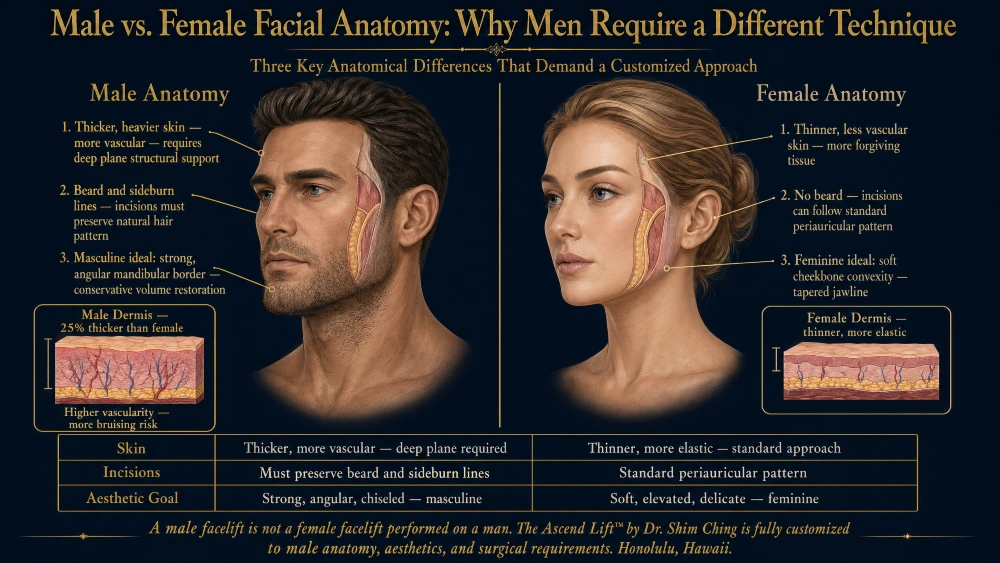
Why Male Deep-Plane Facelift Surgery Requires More Than a Generic Technique Label
There is no separate board certification called “male deep-plane facelift surgeon,” and a technique label alone does not establish quality. The important question is whether the surgeon can explain why a particular plane, vector, incision design, and extent of treatment fit your anatomy and goals.
A deep-plane facelift is a technique that works beneath the superficial muscular layer to reposition deeper facial tissues. In a male patient, that deeper work has to be integrated with visible surface landmarks: the beard line, sideburn, tragus and ear contour, hairline, and neck. The surgical discussion should be specific to you, not limited to the phrase “deep plane.”
Male cases also call for a deliberate safety plan. Published facelift studies have historically identified male sex as a risk factor for postoperative hematoma, a collection of blood under the skin. That does not mean a man should assume he will have a complication. It does mean that blood pressure, medications and supplements, nicotine exposure, health history, facility protocols, and postoperative instructions deserve a clear conversation before surgery.
The practical takeaway is simple: a man considering a deep-plane facelift should look for a surgeon who can discuss male cases in detail—not only show a technique name. Ask how your beard line and hairline will be planned, why the proposed surgical plane is appropriate, how risk factors are reviewed, and what recovery support looks like.
Scars, Beard Lines, and Hairline Planning
Scar planning in men is not a cosmetic afterthought. The incision must balance concealment with the need to avoid moving beard-bearing skin to an unnatural location. Depending on the person’s anatomy and hair pattern, a surgeon may need to make different tradeoffs around the front of the ear, the tragus, the sideburn, behind the ear, and the hairline.
The goal is not to promise an “invisible” scar. Every incision heals differently, and scar quality can be affected by skin type, tension, healing, nicotine exposure, and postoperative care. The goal is a thoughtful incision plan, honest discussion of tradeoffs, and enough time for scar maturation. Ask your surgeon to explain the plan directly on your face and to show comparable male examples when available.
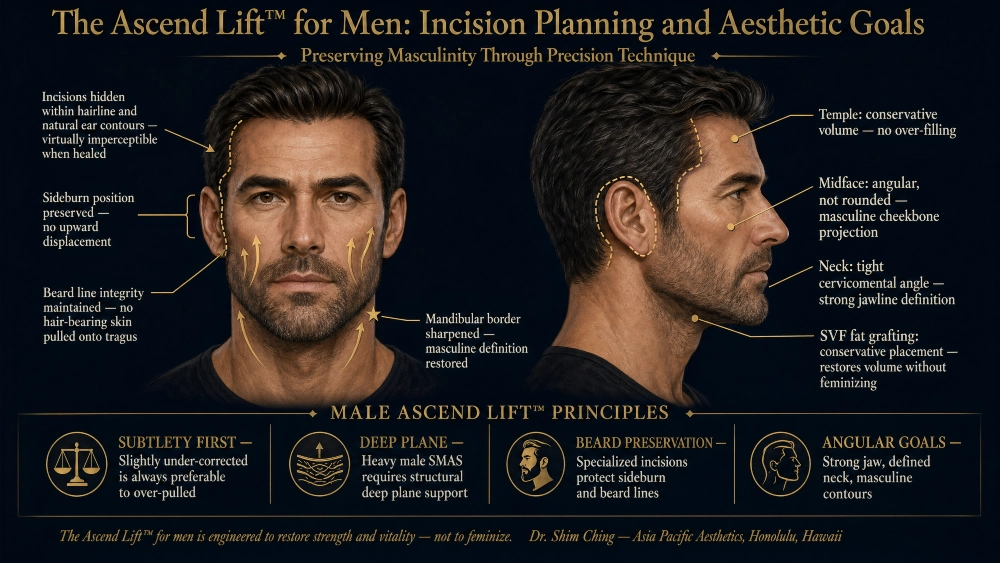
Does Every Man Need a Deep-Plane Facelift?
No. Some patients may be better served by a neck-focused procedure, a lower facelift, eyelid surgery, conservative volume restoration, skin treatment, or no surgery at all. A deep-plane approach may be considered when the examination shows that deeper facial tissues need repositioning, but it is not a shortcut around proper diagnosis or an automatic answer for every man.
The consultation should connect the recommendation to what you see in the mirror. For example: Is the primary concern loose neck skin, heavy jowls, descended cheek tissue, hollowing, tired-looking eyes, skin texture, or a combination? A surgeon should be able to explain what the recommended operation can address, what it cannot address, and whether another treatment should be combined or staged.
For a plain-language comparison of deep-plane concepts and questions to ask, see The Ascend Lift™ vs. Deep Plane Facelift.
What a Natural Male Result Should Preserve
A natural male result should look like the same person, rested and proportionate. It should not depend on pulling skin tightly or applying volume in a standard pattern. In an individualized plan, structural lift, volume restoration, and skin quality are considered separately because facial aging is not one problem.
When volume restoration is discussed, it should be conservative and specific. Some men benefit from addressing deflation around the midface, temples, or lower eyelids; others do not need added volume in those areas. The decision should follow a physical examination and a discussion of what would look balanced for that patient’s own facial structure.
How to Evaluate Male Facelift Before-and-After Photos
Before-and-after photos can be useful only when you know what to look for. Search for cases with a beard pattern, hairline, skin quality, degree of neck laxity, and facial structure similar to yours. Then look beyond the jawline.
- Beard and sideburn continuity: Do the hair-bearing landmarks still look natural?
- Ear and tragus area: Is the incision area shown clearly enough to evaluate?
- Neck and jawline: Does the improvement look balanced rather than pulled?
- Facial identity: Does the person still look recognizable and proportionate?
- Photo conditions: Are angle, lighting, expression, grooming, weight, and time point reasonably matched?
Planned addition: Dr. Ching’s consented male Ascend Lift before-and-after photographs should appear here once they are added to the microsite. Each case should identify the postoperative interval and include a reminder that every surgical plan, recovery, and outcome is individual and photographs do not guarantee a similar result.
Safety and Recovery: Questions Worth Asking Before You Commit
Facelift surgery involves real risks, including bleeding, infection, changes in sensation, nerve injury, poor wound healing, hair loss at incision sites, unfavorable scarring, asymmetry, and an unsatisfactory result. These risks are uncommon but important enough to discuss directly before consent. The ASPS risk and safety guidance is a useful independent resource.
Recovery is gradual and personal. Early swelling and bruising are expected. A plan for work, travel, exercise, social events, shaving, hair care, and driving should be based on the actual procedure and your healing—not a generic calendar. The ASPS recommends discussing care of the surgical site, dressings, medications, activity, and warning signs with your surgeon.
Before surgery, be prepared to discuss medical conditions, allergies, prior operations, medications, vitamins, supplements, tobacco or nicotine use, alcohol, and other factors that can affect safety. Arrange the support your surgeon recommends for the immediate recovery period.
How to Choose a Surgeon for a Male Facelift
Start with credentials and facility safety. The ASPS recommends confirming appropriate board certification and surgery in an accredited, state-licensed, or Medicare-certified facility. Then move to questions that are specific to male facial surgery.
- Can you show male cases with a beard pattern, hairline, neck, and goals similar to mine?
- How will you plan my incision around my beard, sideburn, ear, and hairline?
- Why are you recommending this technique and this extent of surgery for me?
- How do you assess and manage bleeding risk, blood pressure, medications, and nicotine exposure?
- Where will surgery and recovery take place, and who is involved in anesthesia and aftercare?
- What should I expect in the first days, weeks, and months—and what concerns should prompt a call?
For a broader surgeon-selection checklist, see Choosing a Facelift Surgeon in Honolulu.
Frequently Asked Questions
Is a deep-plane facelift different for men?
A deep-plane facelift uses a deeper surgical plane to reposition facial tissues. In men, the plan must also account for beard-bearing skin, sideburn and hairline position, thicker soft tissue, neck anatomy, individual facial proportions, and medical risk factors. Whether a deep-plane approach is appropriate depends on the individual examination and goals.
Why is a male deep-plane facelift more specialized?
A separate credential called a male deep-plane facelift surgeon does not exist. However, male cases can require more specific planning around facial-hair patterns, visible scar placement, tissue thickness, vascularity, neck contour, and a patient’s desired degree of definition. A surgeon should be able to explain the incision plan, treatment plane, safety plan, and relevant male results for the individual patient.
Will a male facelift change my beard line?
Beard and sideburn patterns are important parts of male facelift planning. Incision design is individualized to reduce unwanted movement of hair-bearing skin and to place scars as thoughtfully as anatomy allows. Ask the surgeon to examine your beard density, sideburn position, ear anatomy, hairline, and hairstyle before recommending an incision pattern.
Are men at higher risk of bleeding after facelift surgery?
Published facelift studies have historically identified male sex as a risk factor for postoperative hematoma, or a collection of blood under the skin. Individual risk also depends on blood pressure, medications and supplements, nicotine exposure, health history, and procedure details. Ask how these factors are reviewed and managed before surgery.
How long is recovery after a male facelift?
Recovery is individual. Swelling and bruising are expected early, and the timing for work, social events, shaving, hair care, driving, exercise, and travel depends on the procedure and how you heal. Your surgeon should give a personal recovery plan rather than a one-size-fits-all timetable.
What should I look for in male facelift before-and-after photos?
Look for patients with a comparable hairline, beard pattern, skin quality, neck laxity, and facial structure. Review the ear and tragus area, sideburn placement, beard-line continuity, neck contour, jawline, and whether the images use matching angles, lighting, grooming, and postoperative time points.
Can fat grafting be part of a male facelift?
It can be considered when an examination shows meaningful volume loss, but it is not required for every patient. The plan should be tailored to the patient’s facial structure and goals, with an emphasis on preserving a recognizable, proportionate appearance rather than using a standard volume template.
How do I choose a surgeon for a male facelift?
Verify appropriate board certification and facility credentials, then ask to see relevant male cases. Ask how the surgeon plans the incision around your beard and hairline, why a particular technique is recommended, how bleeding risk is managed, what the recovery plan is, and what happens if a complication occurs.
Sources and Further Reading
- American Society of Plastic Surgeons: Facelift Surgery
- American Society of Plastic Surgeons: Facelift Risks and Safety
- American Society of Plastic Surgeons: Facelift Recovery
- Deep Plane Technique for Male Facelift Surgery
- Preoperative Risk Factors and Complication Rates in Facelift Surgery
Considering a Male Facelift?
A private evaluation can determine whether your concerns are best addressed with a facelift, neck treatment, volume restoration, skin treatment, another procedure, or no surgery at all. Dr. Ching can review your facial anatomy, beard and hairline patterns, goals, health history, and the options that fit your situation.
Request a Private Evaluation(808) 585-8855